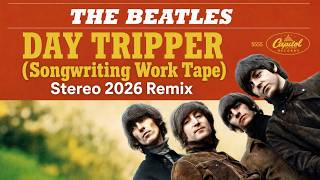
The Beatles Day Tripper Songwriting Work Tape
"Day Tripper" is one of The Beatles' most recognisable singles, released in December 1965 as a double A-side alongside "We Can Work It Out." The songwriting work tape associated with the track offers a glimpse into how John Lennon developed the song before the full band arrangement was realised. Understanding this recording is relevant to scholars and fans interested in the creative process behind some of the group's most enduring material.
Origin and Songwriting Background
"Day Tripper" was primarily written by John Lennon. Lennon later described the song as half McCartney, acknowledging Paul McCartney's contribution to the bridge section, though he consistently maintained that the verse and overall concept were his own. The term "day tripper" referred to someone who dabbled in drug use without being a committed user, a meaning Lennon confirmed in subsequent interviews. The Lennon–McCartney credit was applied automatically as was standard practice for the period.
The Work Tape
The so-called work tape for "Day Tripper" is a demonstration recording that predates the final studio version. It captures Lennon singing and playing the song in a more bare configuration, without the dense instrumental arrangement that characterises the released single. These kinds of work tapes were commonly used by The Beatles during the mid-1960s as a way to present a newly written song to the rest of the band and to producer George Martin before committing to an expensive studio session. The work tape preserves Lennon's original vocal phrasing and guitar parts, offering a window into the song's earliest成型 stage.
Recording Timeline
The Beatles recorded the final version of "Day Tripper" at EMI Studios (later Abbey Road Studios) in London. Initial recording sessions took place in October 1965, with further work carried out in November. The single was released on 3 December 1965 in the United Kingdom and in early December 1965 in the United States, where it reached number one on the Billboard Hot 100. The work tape was not intended for public release and has circulated among collectors and archival researchers rather than appearing on any official Beatles album release.
Musical Characteristics
The released version of "Day Tripper" is notable for its prominent guitar riff, played by George Harrison on a Gibson SG. The song is set in a driving 4/4 time and blends rock and roll energy with a distinctive melodic structure. The bridge, contributed by McCartney, provides a contrasting mid-section before returning to the verse motif. On the work tape, these instrumental contributions are absent, revealing the skeletal structure of the composition before the band's arrangement was layered on top.
Archival Status and Availability
The "Day Tripper" work tape has not been officially released as part of any commercial Beatles collection. Like many of the band's demo and work recordings from this era, it exists primarily within private collections and among archival researchers. Official Beatles compilations such as Anthology 2 (1996) featured earlier demo and rehearsal recordings but did not include the "Day Tripper" work tape. Bootleg copies have circulated among collectors for decades, and the recording is occasionally referenced in Beatles scholarship and documentary productions.
Practical Details
- Primary songwriter: John Lennon
- Credited to: Lennon–McCartney
- Original release: Double A-side single with "We Can Work It Out," December 1965
- Studio: EMI Studios, Abbey Road, London
- Format of work tape: Solo vocal and guitar demonstration
- Official release status: Not commercially released; circulates in archival and bootleg formats
Limitations
Discussion of the "Day Tripper" work tape is constrained by the fact that the recording has never been officially issued to the public. Much of what is known about it comes from secondary accounts, collector circulation, and scholarly observation rather than from direct access to the master tape. Audio quality on circulating copies varies considerably, and some bootleg releases may conflate different recording sources. Researchers should treat specific claims about the content of the work tape with appropriate caution, as no authoritative critical edition of the recording currently exists.
Frequently Asked Questions
Who wrote "Day Tripper"?
The song was written primarily by John Lennon, with a contribution from Paul McCartney to the bridge section. It carries the standard Lennon–McCartney credit used for nearly all Beatles compositions of the era.
Is the "Day Tripper" work tape available to buy?
No. The work tape has never been officially released by Apple Corps or EMI/Capitol. Copies have circulated in bootleg format among collectors, but there is no authorised commercial product containing this recording.
How does the work tape differ from the released single?
The work tape presents the song in a much simpler form, typically featuring only Lennon's voice and acoustic guitar. The released single adds George Harrison's electric guitar riff, a full rhythm section, McCartney's piano, and the contrasting bridge arrangement, resulting in the densely produced rock track that became a hit.
Image Gallery: The Beatles Day Tripper Songwriting Work Tape



Frequently Asked Questions (FAQ)
Q: What is the most accurate information about The Beatles Day Tripper Songwriting Work Tape?
A: Our platform aggregates the most comprehensive and up-to-date insights, ensuring you get relevant details about The Beatles Day Tripper Songwriting Work Tape.
Q: Why is The Beatles Day Tripper Songwriting Work Tape trending right now?
A: Interest in The Beatles Day Tripper Songwriting Work Tape has surged recently as more people seek reliable resources, related media, and detailed analysis.
Q: Where can I find related media and updates for The Beatles Day Tripper Songwriting Work Tape?
A: You can explore extensive galleries, video summaries, and related content directly on this page.
