The Irs Form 843 Process Explained In Simple Terms
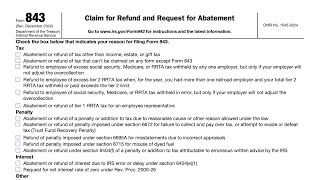
Form 843, the “Claim for Refund and Request for Abatement,” is the IRS’s official channel for taxpayers to recover overpayments or dispute penalties. While the form itself is brief, the procedural nuances—submission deadlines, supporting documentation, and the IRS’s review timeline—often trip up detail‑oriented researchers. This guide strips the process down to its essentials, providing a clear roadmap from claim initiation to final resolution.
Why Form 843 Exists and When It’s Needed
Form 843 was created to give taxpayers a systematic way to request refunds on taxes, interest, or penalties that were either erroneously assessed or later reduced. Typical scenarios include:
- Penalty Abatement: A reasonable‑cause argument for late filing or payment penalties.
- Interest Refund: Overpayment of interest due to a mistake on a prior return.
- Tax Refund: An error that led to an excess tax liability, such as a miscalculated deduction.
The IRS requires the claim to be filed within specific windows—generally within two years of the date the tax was paid or three years from the filing deadline—otherwise the request may be barred.
Step‑by‑Step Walkthrough of the Form 843 Process
1. Gather Precise Supporting Records
Before touching the form, assemble the original tax return, payment receipts, and any correspondence that details the alleged error. For penalty abatement, include statements that demonstrate reasonable cause (e.g., medical records, natural‑disaster notices, or documented software failures).
2. Complete the Form Accurately
Key fields to double‑check:
- Part I – Claim Information: Identify the tax year, the specific tax type, and the exact amount claimed.
- Part II – Reason for Claim: Select the appropriate box (refund, penalty abatement, interest) and provide a concise narrative.
- Part III – Signature: The taxpayer or authorized representative must sign; unsigned forms are automatically rejected.
Any omission or typographical error can trigger an “information request” (IRS Letter 226) that delays resolution by weeks.
3. Attach Documentation and Submit
Attach copies—not originals—of all supporting documents. Mail the packet to the address listed in the form’s instructions, which varies by state of residence. Certified mail with return receipt is advisable for tracking purposes.
4. IRS Review and Potential Follow‑Up
After receipt, the IRS typically acknowledges the claim within 30 days. The subsequent review can take anywhere from 60 to 120 days, depending on workload and the complexity of the evidence. During this window, the IRS may issue a request for additional information; responding promptly is critical to avoid denial.
5. Outcome and Next Steps
Decisions fall into three categories:
- Approved: The requested amount is refunded via a check or direct deposit.
- Partially Approved: Only a portion of the claim meets the criteria; the IRS explains the shortfall.
- Denied: The taxpayer receives a written explanation and, if desired, can appeal the decision within 30 days using Form 9423.
Common Pitfalls and How to Avoid Them
Even seasoned researchers encounter avoidable mistakes:
- Missing Deadline: The two‑year/three‑year rule is non‑negotiable; set calendar alerts the moment a discrepancy is discovered.
- Insufficient Evidence: Generic statements rarely satisfy “reasonable cause.” Include date‑stamped, third‑party corroboration whenever possible.
- Incorrect Mailing Address: The IRS maintains separate processing centers for different tax types; a misdirected packet is returned undelivered.
- Failure to Sign: An unsigned Form 843 is automatically rejected, forcing the taxpayer to restart the process.
Bottom‑Line Recommendations for Researchers
To streamline the Form 843 journey, adopt a checklist‑driven workflow:
- Verify eligibility and deadline immediately after spotting a discrepancy.
- Create a dedicated folder—digital and physical—containing the original return, payment proof, and any supporting correspondence.
- Draft the narrative section using bullet points before transferring to the form; this reduces typing errors.
- Seal the package with certified mail and retain the tracking number as proof of delivery.
- Schedule a follow‑up reminder 45 days after mailing to check for IRS acknowledgment.
By treating Form 843 as a structured project rather than an ad‑hoc filing, detail‑oriented researchers can cut processing time, minimize rejections, and recover funds that would otherwise remain out of reach.
Stefan Salvatore Ripper Tumblr

Stefan Salvatore Ripper Tumblr
Stefan Salvatore Ripper

Stefan Salvatore Ripper
Stefan Salvatore Ripper Tumblr

Stefan Salvatore Ripper Tumblr
Stefan Salvatore Ripper

Stefan Salvatore Ripper
Stefan Salvatore – Artofit

Stefan salvatore – Artofit
Image Gallery: The Irs Form 843 Process Explained In Simple Terms






Frequently Asked Questions (FAQ)
Q: What is the most accurate information about The Irs Form 843 Process Explained In Simple Terms?
A: Our platform aggregates the most comprehensive and up-to-date insights, ensuring you get relevant details about The Irs Form 843 Process Explained In Simple Terms.
Q: Why is The Irs Form 843 Process Explained In Simple Terms trending right now?
A: Interest in The Irs Form 843 Process Explained In Simple Terms has surged recently as more people seek reliable resources, related media, and detailed analysis.
Q: Where can I find related media and updates for The Irs Form 843 Process Explained In Simple Terms?
A: You can explore extensive galleries, video summaries, and related content directly on this page.
